Electrical Inspection Before Selling or Buying a Lake Arrowhead Home: What General Home Inspectors Miss
Electrical Inspection Before Selling or Buying a Lake Arrowhead Home: What General Home Inspectors Miss
The home inspector you hired for your Lake Arrowhead transaction is a generalist. They walk the roof, test the appliances, check for visible water damage, and pull the panel cover off to confirm there's nothing obviously wrong. On a 1985 mountain cabin in Blue Jay, Cedar Glen, or Twin Peaks, "nothing obviously wrong" usually means the inspector didn't find a fire hazard. It does not mean the electrical system is sound, code-compliant, or safe to depend on for the next decade.
This is the gap that costs Lake Arrowhead buyers and sellers real money every year. Buyers inherit unpermitted work that surfaces during a remodel two years later. Sellers find out two days before closing that a panel they've used for fifteen years won't pass a re-inspection. Both situations are preventable with a separate electrical inspection from a licensed C-10 contractor — and on Lake Arrowhead-area properties specifically, the inspection isn't optional. It's due diligence.
Here's what a real electrical inspection covers, what it costs, and why it matters more on a mountain cabin than on a tract home in the valley.
Why Lake Arrowhead Properties Need a Specialized Electrical Inspection
A general home inspector in California typically holds a CREIA or InterNACHI certification. They're trained to spot obvious safety issues across all home systems — roof, plumbing, HVAC, structure, electrical. They are not licensed electricians. The standard general home inspection report on a Lake Arrowhead cabin will catch missing GFCI outlets in a bathroom and note that the panel is "older" or "may be obsolete." It will not catch:
- Federal Pacific Stab-Lok, Zinsco, or Pushmatic panels with known safety defects
- Aluminum branch wiring that's been spliced into copper without proper connectors
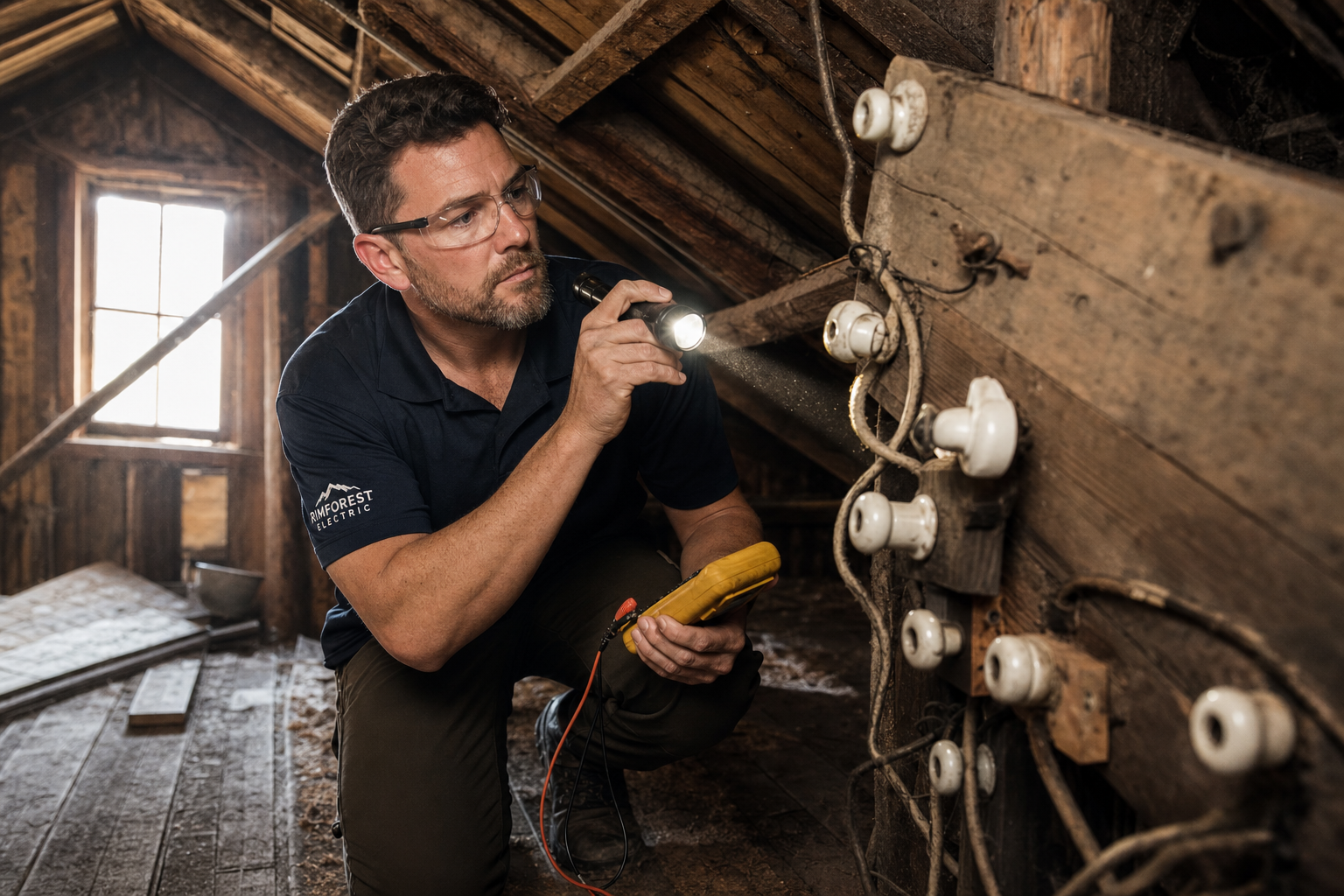
- Knob-and-tube wiring buried in attic insulation (still present in some pre-1960 cabins around Cedar Glen and Skyforest)
- Unpermitted hot tub circuits, EV chargers, or generator installations added by previous owners
- Improperly bonded sub-panels in detached garages or guest cabins
- Service entrance issues that aren't visible from the meter
- Heat tape circuits that aren't GFCI-protected
- Well pump circuits that don't meet current code
- Smoke detector and CO detector compliance gaps for short-term rental conversion
- Structural attic fires waiting to happen because of decades of marginal connections
A licensed C-10 electrical contractor with mountain cabin experience catches all of this. The training, equipment, and code knowledge are different.
Lake Arrowhead's housing stock makes the difference matter more. A significant portion of the homes in Lake Arrowhead, Blue Jay, Crestline, Running Springs, Cedar Glen, Twin Peaks, and Rim Forest were built between 1955 and 1985 as weekend retreats. Most have been modified, expanded, and partially renovated multiple times by owners who weren't full-time residents and weren't always pulling permits. The result is electrical systems that look fine until somebody actually opens them up and traces the wiring.
That's the inspection.
What a Licensed Electrical Inspection in Lake Arrowhead Actually Covers
A real pre-purchase or pre-listing electrical inspection on a mountain cabin includes:
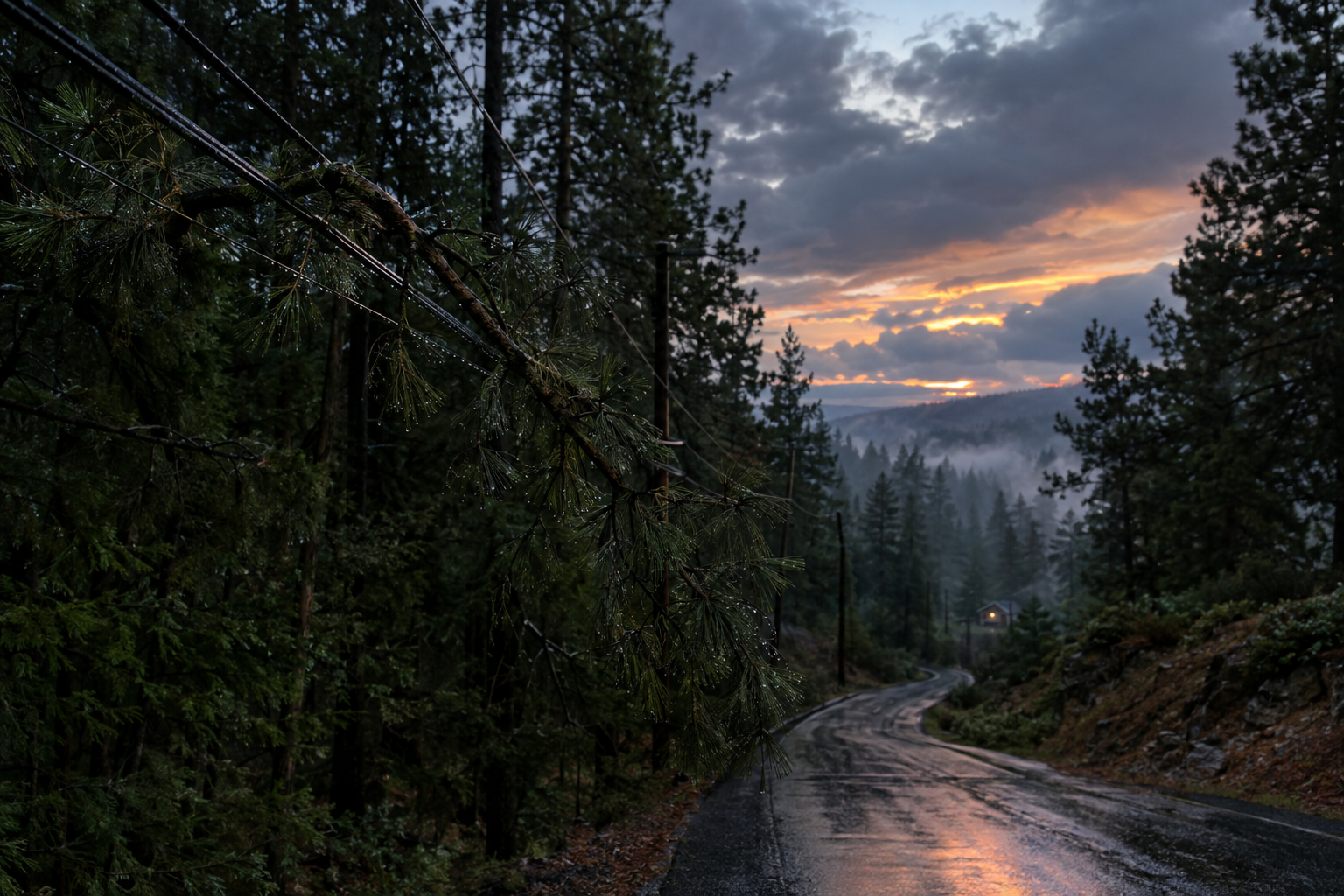
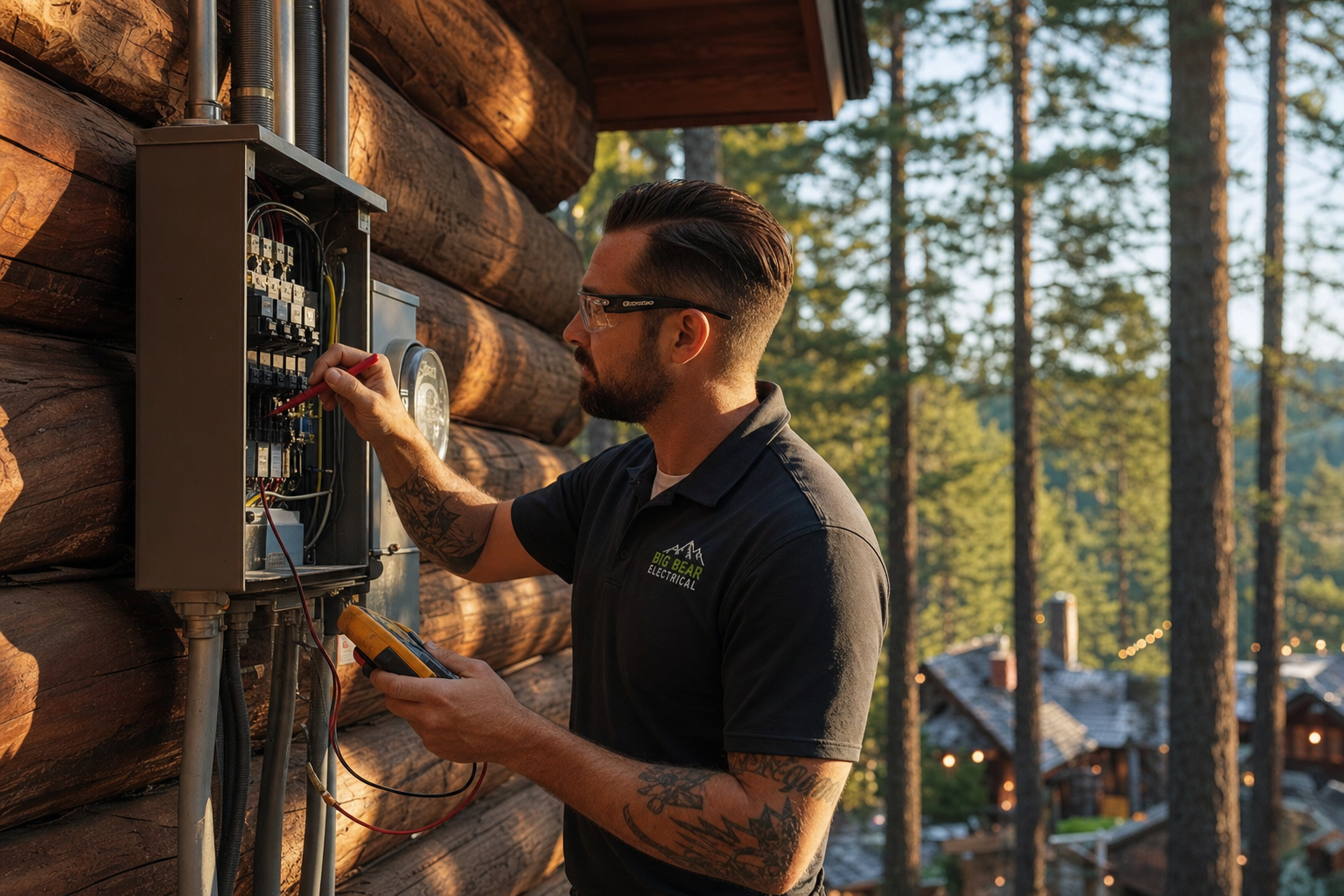
1. Service entrance and meter base. Visual inspection of the meter, mast, weatherhead, and service drop. Cabin service drops in the San Bernardino Mountains take a beating from snow load, falling branches, and freeze-thaw cycles. Loose fittings, corroded weatherhead caps, and damaged service masts are common — and they're all on the homeowner's side of the meter, meaning they're the homeowner's problem.
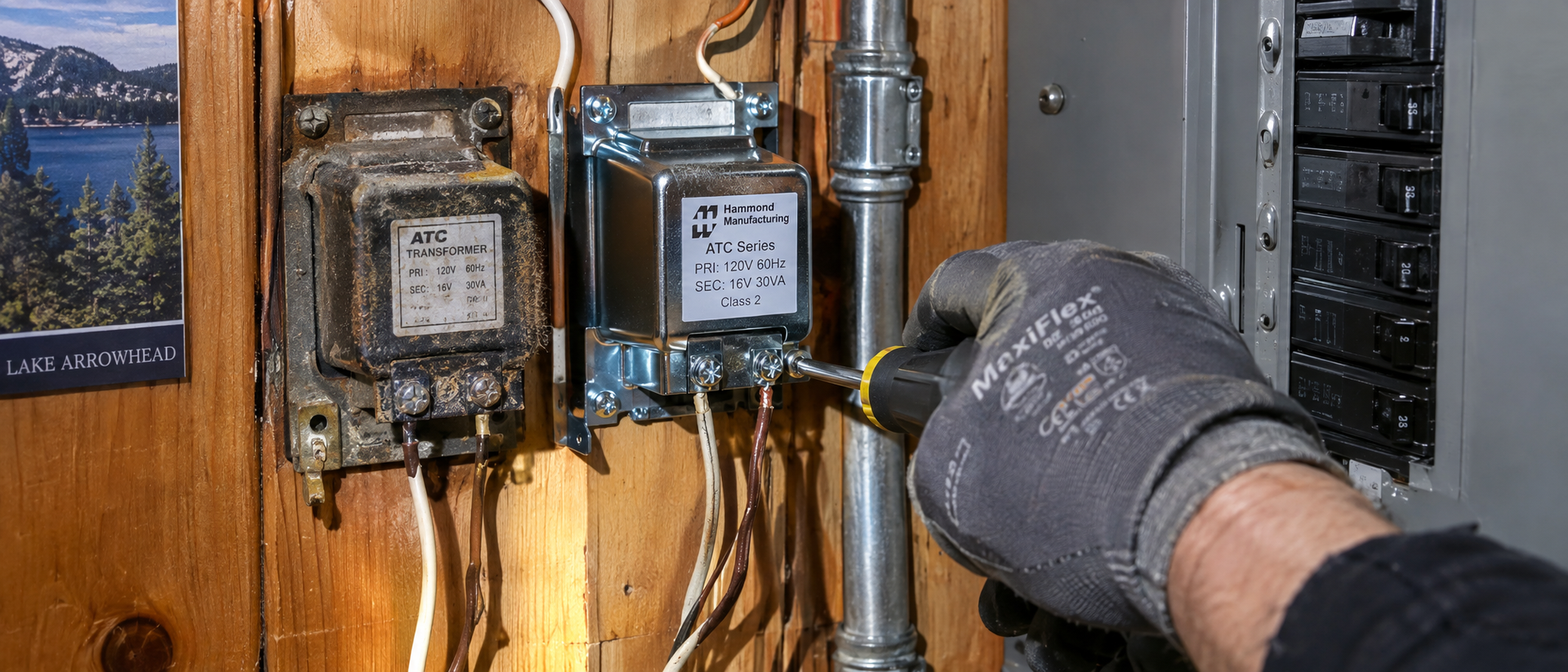
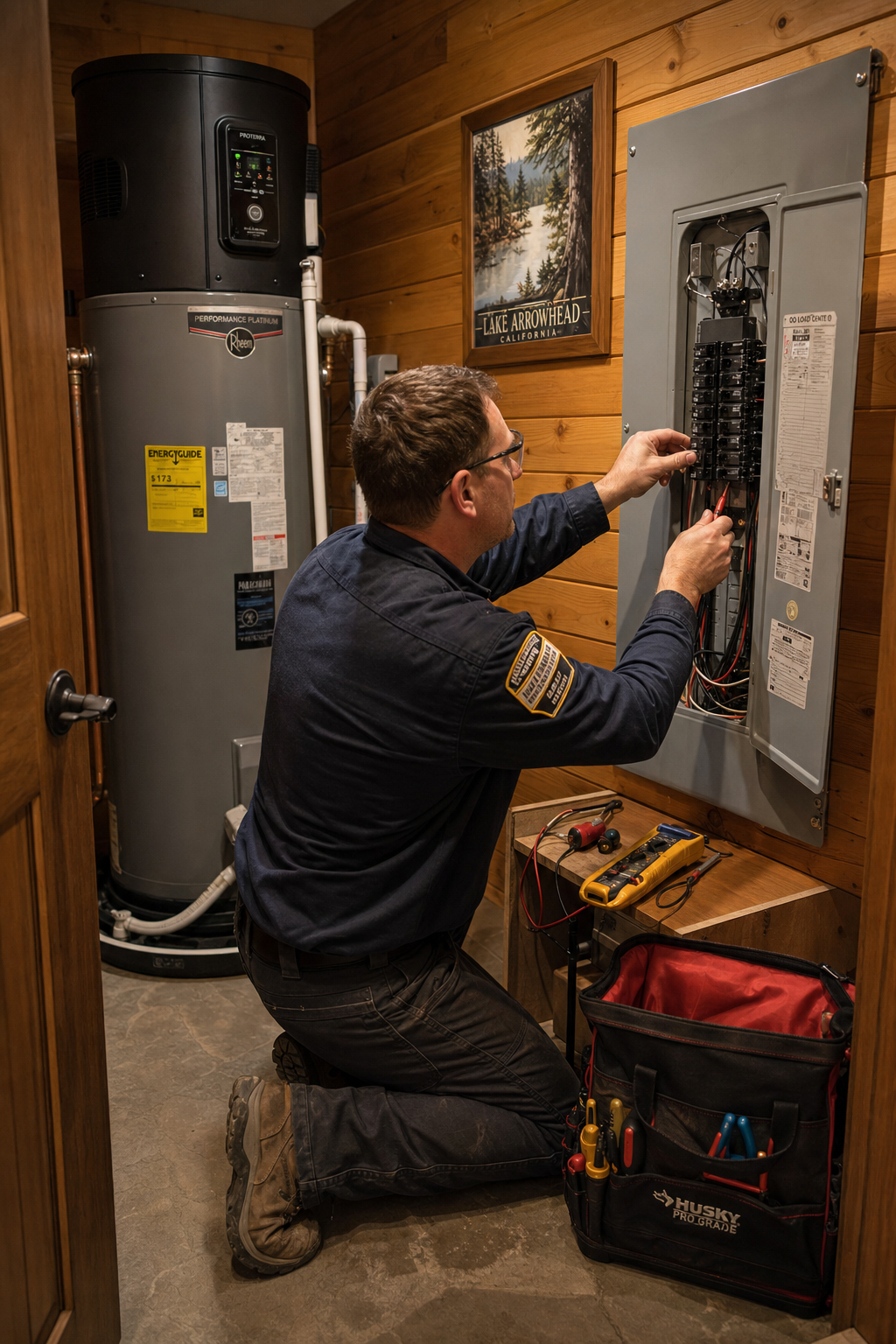
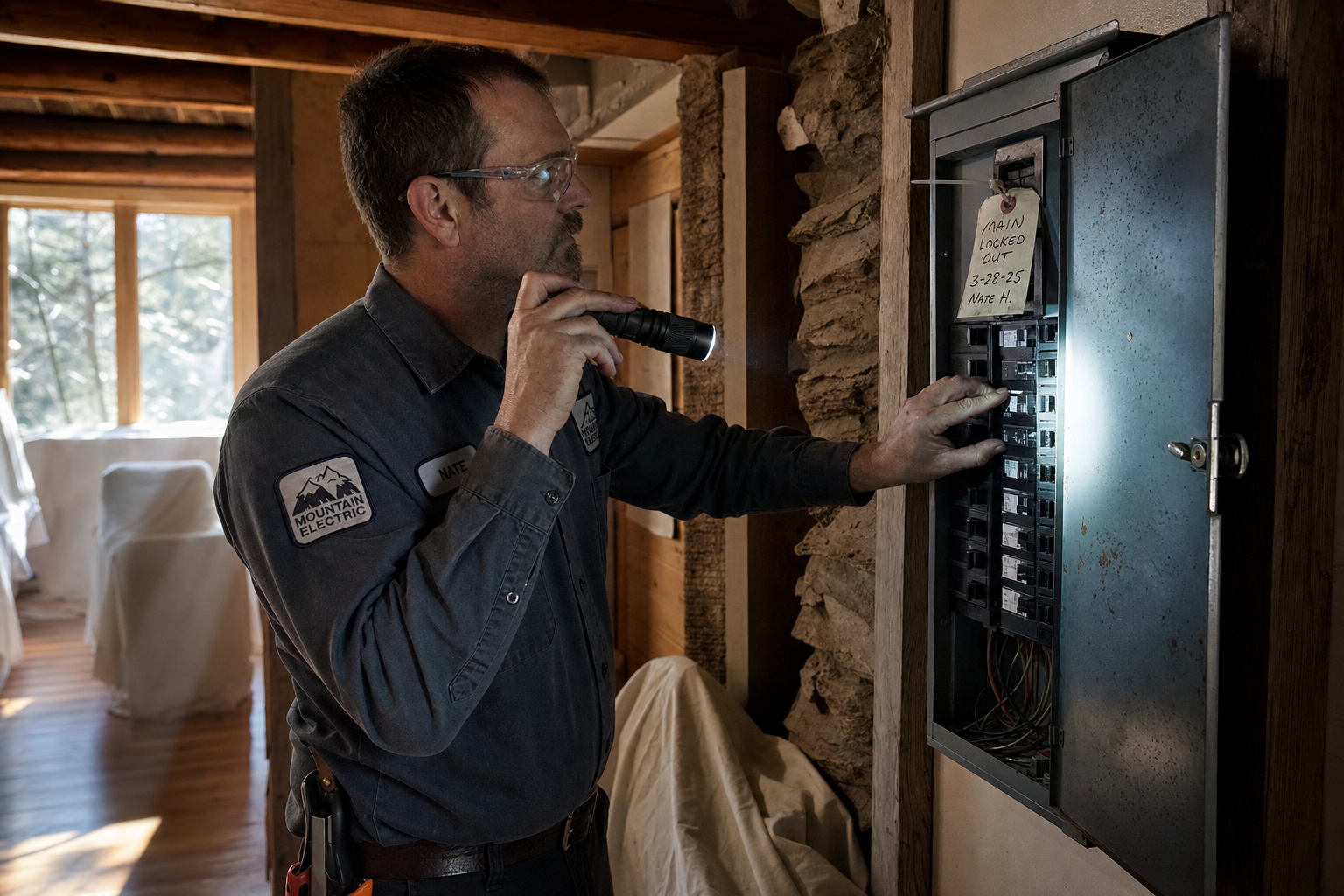
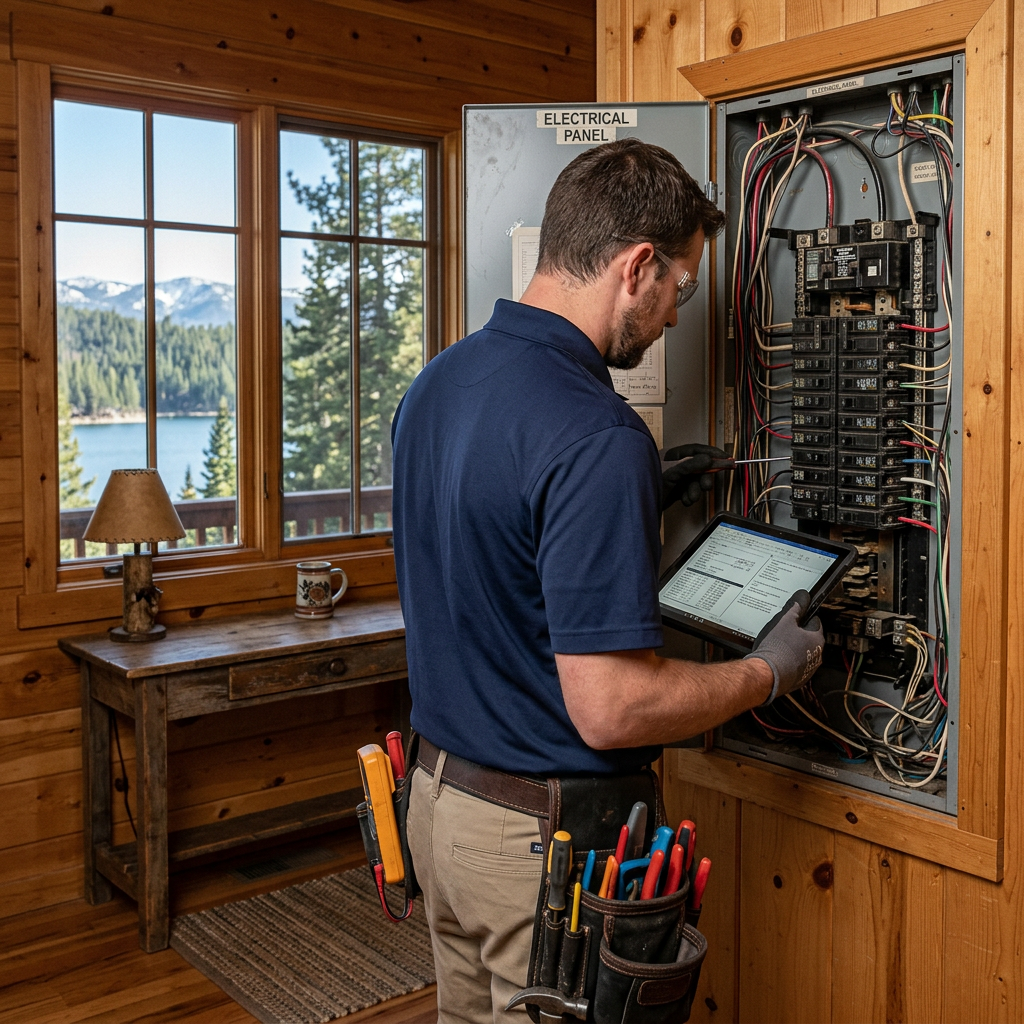
2. Main electrical panel. Cover off, breakers tested, bus bars inspected, neutral and ground separation verified, manufacturer and model identified. Federal Pacific, Zinsco, and Pushmatic panels are flagged. Panel age, capacity (60-amp, 100-amp, 150-amp, 200-amp), and condition are documented in writing.
3. Sub-panels. Detached garage panels, guest cabin panels, workshop panels. Sub-panel grounding and bonding errors are one of the most common issues found in Lake Arrowhead cabin inspections — they're invisible during normal use but create code problems and shock hazards.
4. Branch circuit verification. Tracing major circuits — kitchen, bathroom, exterior, hot tub, generator, EV charger, well pump — to confirm proper sizing, GFCI/AFCI protection where required, and reasonable load distribution.
5. Outlet and switch testing. Sample outlets across the property tested for proper polarity, ground integrity, and GFCI function. Outdoor outlets, garage outlets, and bathroom outlets are tested individually.
6. Smoke and CO detector verification. Count, location, age, and operation. California requires hardwired smoke detectors with battery backup in specific configurations, and the rules tighten on every code cycle. CO detectors are required within 15 feet of every sleeping area in any home with gas appliances, propane heating, or attached garages.
7. Visible wiring inspection. Attic, crawlspace, basement, garage. Knob-and-tube identification. Aluminum wire identification. Improper splices, missing junction boxes, undersized wire feeding modern loads, rodent damage, and water-compromised wiring all get documented.
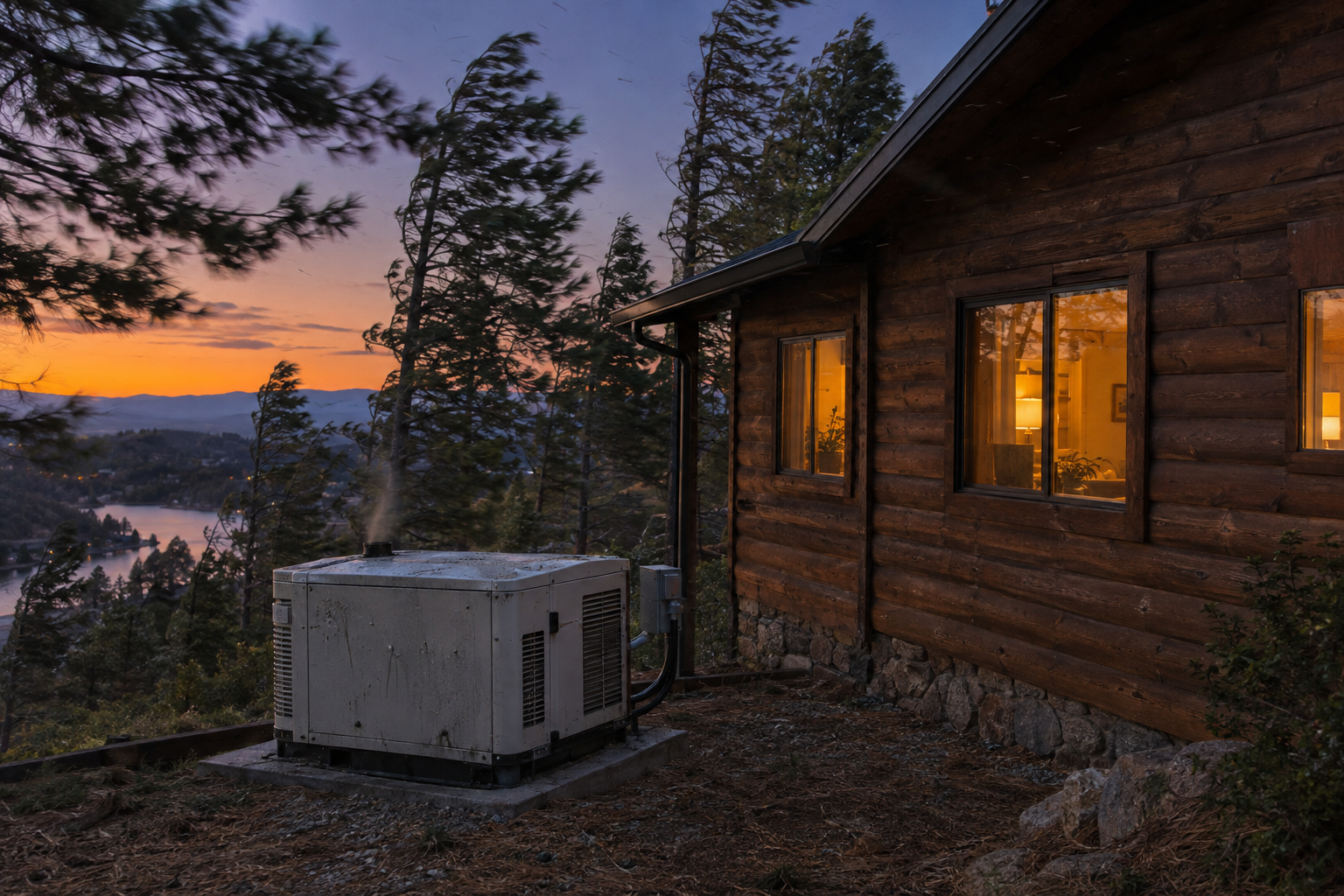
8. Specialty circuit verification. Hot tub circuits, EV chargers, generator transfer switches, well pump controls, snow melt and heat tape circuits. Each gets verified against code requirements (GFCI protection, dedicated circuit, proper disconnect, etc.).
9. Permit history check. Cross-reference visible electrical work against San Bernardino County permit records for the property. Unpermitted work gets flagged in writing — this is where most surprises live in Lake Arrowhead transactions.
10. Written report with photos. A real electrical inspection produces a documented report with photos of issues, code references for any deficiencies, recommended remediation, and rough cost estimates. This is the document buyers and sellers can use to negotiate, sellers can use to address issues proactively, and both sides can use to satisfy lender or insurance requirements.
What This Costs in the Lake Arrowhead Area
Real pricing for a licensed C-10 electrical inspection on a Lake Arrowhead-area property in 2026:
Standard residential inspection (under 2,000 sq ft, single-family cabin): $250 to $450. Includes the full scope above and a written report.
Larger home or estate property (2,000 to 4,000 sq ft): $400 to $750. More circuits, more outlets, multiple panels, longer trace work.
Property with detached structures (guest cabin, workshop, separate garage): $450 to $900. Each detached structure adds time and complexity.
Commercial or short-term rental compliance inspection: $500 to $1,200. STR-specific compliance check including occupancy load calculations, smoke/CO detector verification, GFCI compliance throughout, and documentation suitable for San Bernardino County STR permit.
Real estate transaction inspection with same-day written report: Typically priced at the standard residential rate plus a $75 to $150 expedite fee for expedited turnaround during a contingency window.
These are professional electrical contractor prices. A general home inspector's "electrical section" on a Lake Arrowhead cabin runs $0 to $50 because it's bundled with the overall home inspection — and you get what you pay for. The detail and specificity of a licensed C-10 inspection is fundamentally different.
The math gets simpler when you compare it to what's at stake. A 1972 cabin in Cedar Glen with a Federal Pacific panel and unpermitted hot tub wiring can have $8,000 to $15,000 in remediation work hiding inside a clean general home inspection report. The $400 electrical inspection finds it before the buyer is contractually obligated.
For Buyers: Why You Want This Inspection Before Closing
If you're buying a Lake Arrowhead, Blue Jay, Crestline, or Running Springs property, you have a contractual contingency window — typically 17 days in California — to investigate the home and either renegotiate, ask for credits, or walk away. That window is the entire point of due diligence.
Most buyers use the general home inspection and a termite inspection. On a mountain cabin, those two reports leave a meaningful gap. The electrical inspection closes it.
Specifically, what a licensed electrical inspection finds for buyers:
Federal Pacific, Zinsco, or Pushmatic panels. These are not theoretical risks — they're documented safety defects. Federal Pacific Stab-Lok breakers have a measurable failure-to-trip rate that creates fire risk. Zinsco panels have similar issues. Insurance companies increasingly refuse to write homeowner policies on properties with these panels still installed. If your inspection identifies one, that's a $3,500 to $6,000 panel replacement that should either be done by the seller or credited to you at closing.
Unpermitted electrical work. When a previous owner wired the hot tub themselves, or had a handyman add an EV charger circuit, or finished the basement without permits, the work is unpermitted electrical. At minimum, it's a code compliance issue. At worst, it's a fire hazard, a voided insurance situation, or a problem that surfaces when you sell the property to the next buyer. Knowing about it now lets you negotiate.
Aluminum wiring. California homes built between roughly 1965 and 1973 sometimes have aluminum branch wiring that's prone to loose connections and elevated fire risk. Lake Arrowhead-area cabins from that era are common. Remediation is either a connection-by-connection upgrade with proper anti-oxidant and special connectors (CO/ALR rated devices and AlumiConn or similar splices) or full rewire. The remediation cost varies dramatically depending on extent — knowing the scope before closing matters.
Service entrance condition. If the meter mast is bent, the weatherhead is leaking, or the service drop has been clipping branches for ten years, the inspection catches it. These are repairs the seller should handle.
Smoke and CO detector compliance. California real estate transfer requirements include functioning smoke and CO detectors. Failure to comply is a transfer-of-ownership issue that can complicate closing.
Future use planning. If you're planning to add an EV charger, install solar, add a hot tub, or convert the property to a short-term rental, the inspection tells you what the existing electrical system can support — and what additional work you'll need to budget for after closing.
The inspection report becomes a negotiation document. Sellers frequently address line items, credit at closing, or reduce price based on findings. The cost of the inspection is recovered in the first negotiation that follows from it.
For Sellers: Why You Want This Inspection Before Listing
The other side of the same coin. If you're listing a Lake Arrowhead property in 2026, the buyer is going to inspect. The general home inspector may or may not find issues. A licensed electrician hired by the buyer will absolutely find issues if they exist.
Sellers who get ahead of this with a pre-listing electrical inspection get four advantages:
1. Discover issues before they become deal-killers. Finding unpermitted work, an old panel, or a bonding issue while you have time to address it is much easier than negotiating it during a 17-day contingency window. You can schedule remediation on your timeline, get multiple bids, and complete the work for less than the buyer would have asked you to credit.
2. Document for the buyer. A pre-listing inspection report from a licensed C-10 contractor, included in your seller disclosures, signals professionalism and reduces buyer anxiety. Buyers who see a recent electrical inspection report often skip ordering their own — saving everyone time during the contingency period.
3. Defend your asking price. When the buyer's general home inspector flags something vague ("panel may be near end of useful life" or "electrical service may need updating"), you have an actual professional report from a licensed electrician that either confirms or contradicts. This is the difference between a $5,000 credit demand and a $200 credit demand.
4. Avoid mid-escrow remediation. Discovering you need a panel upgrade three days before closing means rushed work, premium pricing, and potential delays to closing. Discovering it three months before listing means you can shop the work, schedule it for a convenient week, and have the receipts ready for the buyer.
For sellers preparing a Lake Arrowhead property for the spring or summer market, the right time to schedule the inspection is two to three months before listing. That gives you time to address findings before photography, marketing, and showings begin.
What Gets Found Most Often in Lake Arrowhead Pre-Sale Inspections
After enough inspections in the San Bernardino Mountain communities, patterns emerge. The most common findings:
Older panel that's served the property fine but won't satisfy a buyer's lender or insurance. A 1978 100-amp main panel that's worked perfectly for 47 years still gets flagged. Insurance underwriting standards have tightened. Solution is usually a panel upgrade, $2,500 to $4,500.
Unpermitted hot tub wiring. A previous owner installed a hot tub, the wiring was done by someone other than a licensed electrician, no permit was pulled, the disconnect is missing or non-compliant, and there's no GFCI breaker. Solution is bringing the wiring up to code and pulling a retroactive permit, $800 to $2,000.
Detached garage or guest cabin sub-panel with bonding errors. Neutral and ground bonded together at the sub-panel when they should only be bonded at the main. Code violation, easy fix, $200 to $500 if caught early.
Missing GFCI protection in bathrooms, kitchen, garage, or outdoor outlets. Code requirements have evolved. Older cabins frequently have non-GFCI outlets in locations where current code requires them. Replacement of individual outlets, $50 to $150 per location.
Smoke and CO detector deficiencies. California real estate transfer requirements aren't always met by older detector installations. Hardwired smoke detectors with battery backup in every bedroom, hallway outside sleeping areas, and on every level. CO detectors within 15 feet of every sleeping area. Replacement of older detectors and installation of missing ones, typically $400 to $1,200 for a typical cabin.
Knob-and-tube wiring in old attics. Less common but still found in cabins built in the 1940s and 1950s. Insurance companies generally won't write policies on properties with active knob-and-tube. Remediation is full rewire or specific replacement of the knob-and-tube portions, scope-dependent.
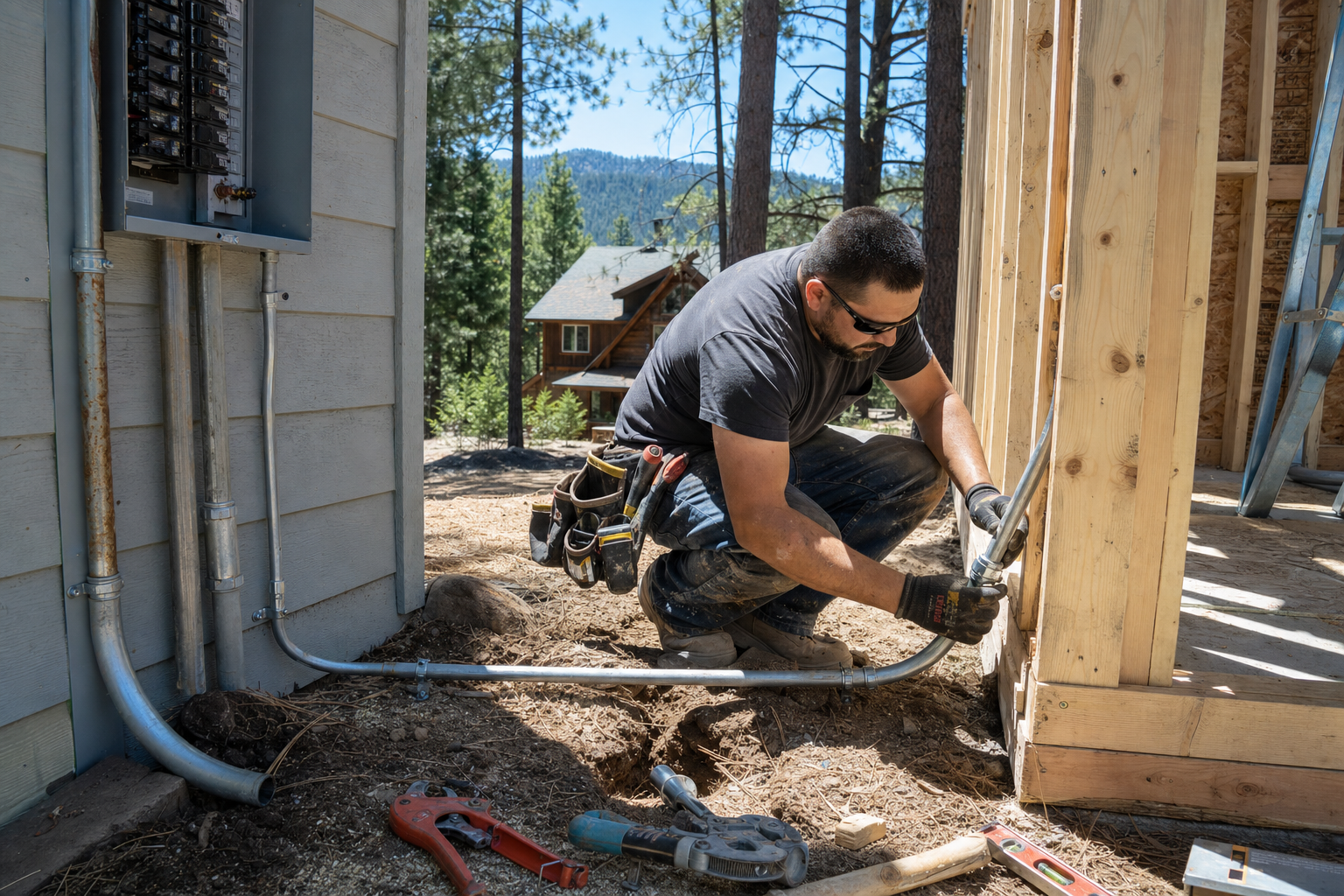
Improperly buried conduit. Outdoor circuit runs that should be buried at code depth that aren't, or that are run in PVC that's become brittle from cold. Often discovered when the property has been adding outdoor amenities (lighting, fountains, sheds) over the years.
Frequently Asked Questions
Is a separate electrical inspection required for a real estate transaction in California? No, not legally required. The general home inspection is the standard. But on Lake Arrowhead-area properties specifically, the additional electrical inspection is becoming a buyer-side standard for cabins over 30 years old. Insurance underwriters and lenders are also increasingly asking for licensed electrical inspections on older mountain properties.
How long does an electrical inspection take? For a standard single-family cabin, 2 to 3 hours on-site, plus another 1 to 2 hours for the written report. Larger homes with detached structures take longer. Same-day or next-day reports are typical when scheduling for a real estate contingency.
Will a licensed electrician work for the buyer or for the seller? Either, but the inspector should be neutral — pre-paid by whoever requested the inspection, with the report going to the requesting party. We don't take seller incentives to soften findings or buyer incentives to inflate them. The whole value of the inspection is the independence.
What if the inspection finds a Federal Pacific or Zinsco panel? Document it in the report with manufacturer model numbers and photos. Recommend replacement with a current panel. Provide a rough cost estimate ($3,500 to $6,000 for a like-for-like replacement on a Lake Arrowhead cabin). The buyer or seller decides how to handle it from there — typically through a credit at closing or seller-side replacement before closing.
Can the same electrician do the inspection and the remediation work? Generally yes — but with a clear conflict-of-interest disclosure. Many sellers prefer to use the same electrician who did the inspection for the remediation because there's no learning curve. Buyers may prefer to use a different electrician for the remediation to avoid any appearance of inflated findings. Both approaches are legitimate.
What about Lake Arrowhead Country Club, Lake Arrowhead Woods, or Skyforest properties specifically? Each community has different cabin vintages and modification histories. Lake Arrowhead Woods has a higher proportion of 1960s-1970s cabins. Skyforest has more older cabins from the 1940s-1950s with knob-and-tube risk. Lake Arrowhead Country Club has more high-end remodels with custom electrical work that's sometimes been done without permits. The inspection scope is the same; the most likely findings vary by community.
Should short-term rental properties get a more comprehensive inspection? Yes. STR-specific inspections include occupancy load calculations, GFCI verification throughout, smoke/CO detector compliance for transient occupancy, hot tub electrical compliance, and documentation suitable for San Bernardino County STR permit applications. The scope is broader and the documentation is more detailed.
What's the difference between an electrical inspection and a "panel inspection" some companies advertise? A panel-only inspection covers the main electrical panel and stops there. A full electrical inspection covers service entrance, panel(s), branch circuits, outlets, fixtures, specialty circuits, and visible wiring. For a real estate transaction, you want the full inspection. Panel-only work is appropriate for verifying a specific panel before a panel upgrade quote, not for transaction due diligence.
Will the report identify everything wrong with the electrical system? The report will identify everything visible and accessible at the time of inspection. Wiring buried inside finished walls, in inaccessible attic or crawlspace areas, or behind permanent fixtures cannot be inspected without invasive methods. The report will note these limitations. For pre-purchase inspection on a property where you have specific concerns, a licensed electrician can sometimes do additional targeted investigation with seller permission.
What does the report look like? Typically 8 to 25 pages depending on findings, including photos of each issue, code references where applicable, recommended remediation, and rough cost estimates. The format is suitable for sharing with the other party in a transaction, the listing agent, or a home insurance underwriter.
Get a Pre-Purchase or Pre-Listing Electrical Inspection in Lake Arrowhead
Lake Arrowhead Electrical performs licensed C-10 electrical inspections throughout Lake Arrowhead, Blue Jay, Crestline, Running Springs, Cedar Glen, Twin Peaks, Rim Forest, and Skyforest. We're locally based at 27264 CA-189, Ste M-01B in Blue Jay — which means same-day and next-day scheduling is realistic, and we know the housing stock by community and vintage.
Every inspection includes service entrance evaluation, main and sub-panel inspection with cover off, branch circuit verification, GFCI/AFCI testing, smoke and CO detector compliance check, specialty circuit verification (hot tub, EV charger, generator, well pump, heat tape), permit history cross-reference with San Bernardino County records, and a written report with photos and remediation cost estimates suitable for use in real estate negotiations or insurance underwriting.
Call (909) 403-4740 to schedule. For real estate transactions with active contingency windows, mention the closing date when you call — we'll prioritize the appointment and turnaround the report on the timeline you need.
Licensed C-10 electrical contractor. Fully insured. Local to the mountain communities we serve.