Why Your New Video Doorbell Chirps All Night in Your Lake Arrowhead Cabin
Why Your New Video Doorbell Chirps All Night in Your Lake Arrowhead Cabin
If you just installed a Ring or Nest doorbell at your cabin and it's chirping randomly, dropping connection, or refusing to hold a charge, the doorbell itself is probably fine. The transformer behind it almost certainly isn't up to the job — not broken, just built for an era of doorbells that didn't need to run a camera and a Wi-Fi radio all day.
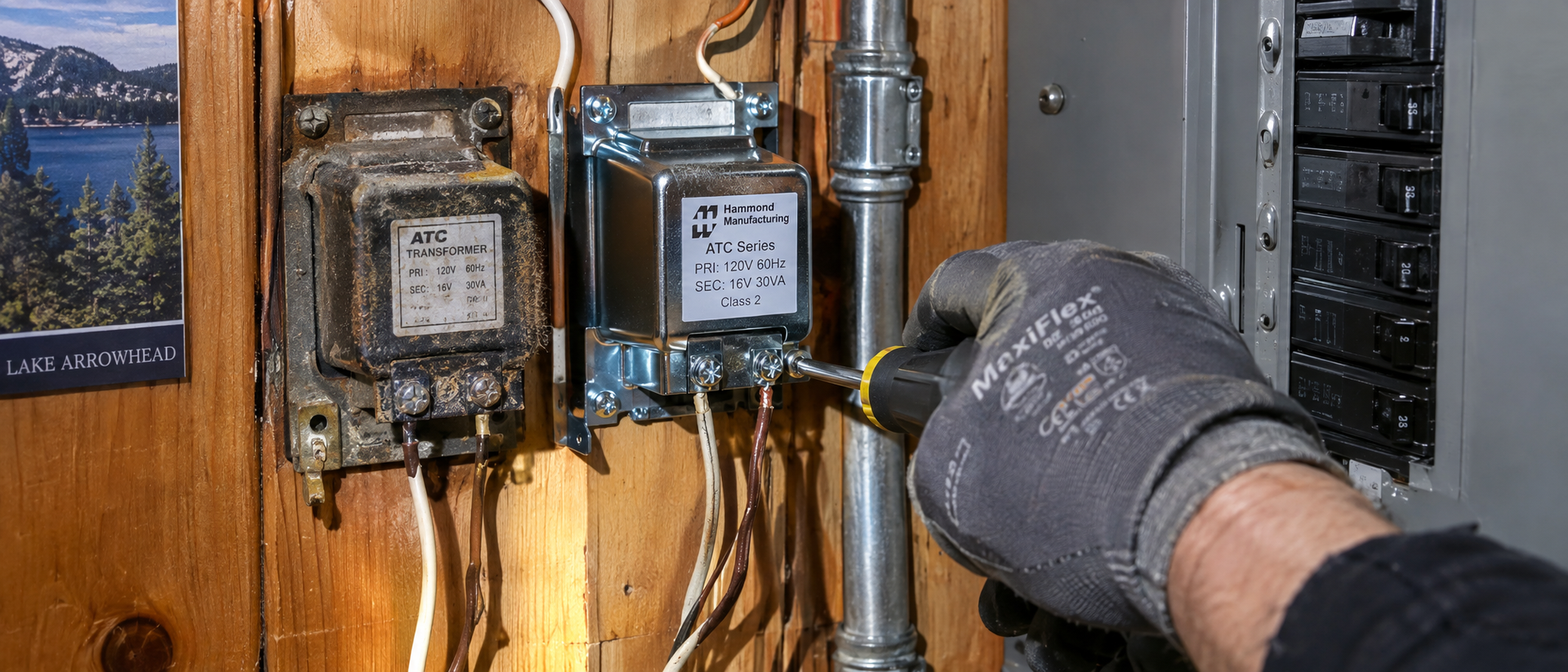
Every hardwired doorbell depends on a small transformer, usually mounted near the main panel or tucked into a utility closet, that steps household voltage down to something a doorbell circuit can actually use. A basic mechanical chime needs very little — 8 to 16 volts and a small, occasional power draw when someone presses the button. A video doorbell asks for something completely different: a continuous, steady supply to keep the camera, processor, and radio running around the clock, not just a brief pulse when the button gets pressed.
Here's roughly where the compatibility line falls, based on what most manufacturers actually specify:
An 8-volt transformer won't run a video doorbell at all. Neither will 10 volts. A 16-volt, 10VA transformer — probably the most common setup sitting behind an older cabin's original chime — lands in a frustrating middle ground: technically the right voltage, but usually not enough sustained power capacity to keep a video doorbell running reliably, which is exactly the setup behind most chirping and intermittent-connection complaints. A 16-volt, 30VA transformer generally handles it fine, and 24 volts at 20VA or higher is about as solid as it gets.
Given how much of Lake Arrowhead's cabin stock dates back decades — the same older construction we've written about across Blue Jay, Twin Peaks, and Rimforest — it's genuinely common to find the original doorbell transformer from whenever the cabin was built still quietly doing its job. That's not a defect. It's just a transformer sized for a chime, meeting a device category that didn't exist when the wiring went in.
Voltage alone doesn't tell the full story, either. VA — volt-amperes — measures how much power the transformer can actually sustain, and a transformer can read the correct voltage while still lacking the VA capacity to keep a camera and radio powered continuously. Wire run length matters too: a long, thin wire run from transformer to doorbell causes voltage drop along the way, which means a transformer testing fine at the source can still deliver too little by the time power reaches the doorbell itself — a real factor on a larger cabin property where that run might be longer than in a typical suburban home.
If you want to check this yourself first, the transformer is usually labeled directly on its housing near the panel, in a utility closet, or near the furnace — look for the voltage and VA rating printed on it, or test it with a multimeter if the label's worn away. If what you find falls into the "not compatible" or "marginal" range, no amount of app troubleshooting or Wi-Fi router adjustments is going to fix what's actually a hardware mismatch.
The good news is this is a quick, inexpensive fix once it's actually diagnosed — swapping in a transformer rated for the doorbell's specific voltage and VA needs, or in some cases using a compatible power kit designed to bypass the old transformer entirely. It's a five-minute non-issue once someone actually identifies it, rather than something people live with for months assuming the doorbell itself is defective.
Video doorbell acting up at your Lake Arrowhead cabin?
It's probably the transformer, not the doorbell. Call (909) 403-4740.